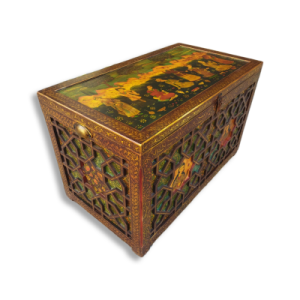
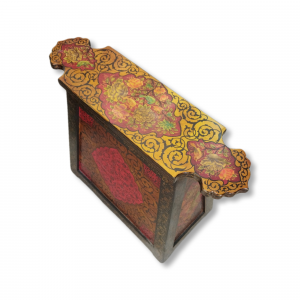
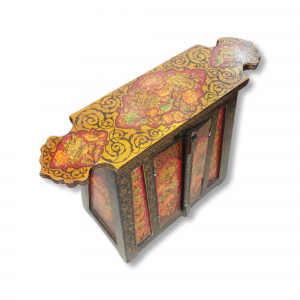
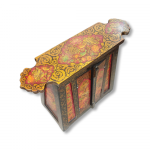
In the past, street vendors used this type of box (called “Kharak”) as a cash register. When traveling to towns or villages across Iran, they would tie it with a rope to their horse or donkey.
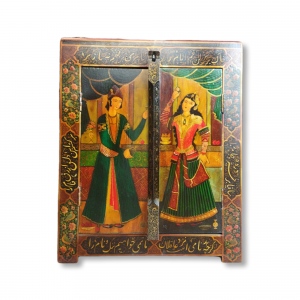
The Qajar painting style encompasses all the thematic and functional characteristics of a distinct painting school.
This style, which emerged during the Qajar era, is a fusion of traditional Persian art with visible influences from European painting techniques and elements.
Although similar works known as “Farangi-sazi” (European-style painting) had appeared during the Safavid period, the style became more refined and developed first during the Zand dynasty and later in the Qajar period.
Art and painting were closely tied to the royal court, with kings and princes being the main patrons and commissioners of artistic works during that time.
During the reign of Fath-Ali Shah, wall painting became prominent. Beautiful wall murals of Agha Mohammad Khan and Fath-Ali Shah in the ruins of Koushki in Karaj are notable examples of Qajar wall paintings.


نقد و بررسیها
هنوز بررسیای ثبت نشده است.