

steel
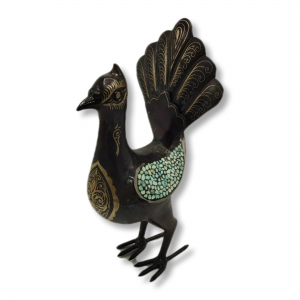
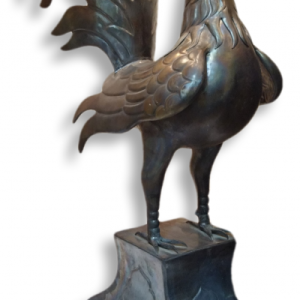
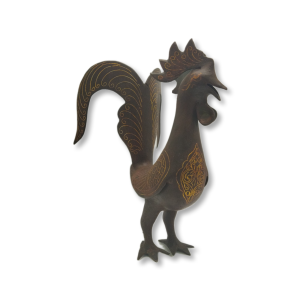
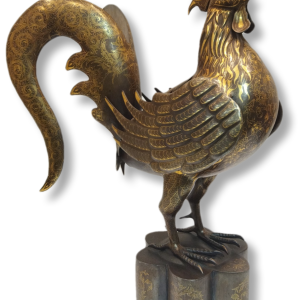
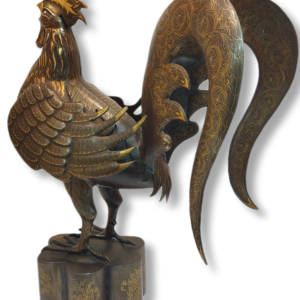
steel rooster statue with gold inlay – code:1000113
Steel Rooster
Entirely Hand-Forged and Handcrafted, Inlaid with 24-Carat Gold
The rooster holds a special place in ancient Iranian culture. Repeatedly mentioned in the writings of historians and in beliefs from pre-Islamic times as well as throughout the Islamic era, the rooster’s role in daily life and symbolism is significant.
The rooster has always been regarded as a sacred and divine bird.
It represents Soroush (the angel of divine order) in the material world. The rooster sees the dawn from afar and announces its arrival. For this reason, it is believed that the rooster is the enemy of the demon of sleep, Bushasya, a fiend that tries to prevent people from waking up to greet the rising sun and perform prayers before sunrise.
Bushasya (or Bushasp) is the demon of excessive sleep and laziness. In Iranian beliefs, the rooster is the guardian of the night and, at dawn, fights against Bushasya to keep people awake.
By announcing the arrival of the dawn and the rising of the sun, the rooster plays a symbolic role in protecting humanity from lethargy and spiritual darkness.
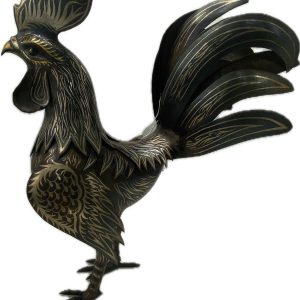
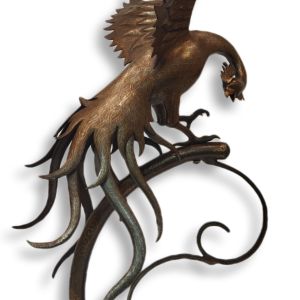
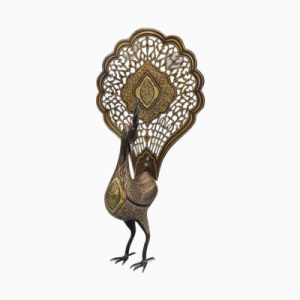
Steel Simurgh – code:1000114
Steel Simurgh
Entirely Inlaid with 24-Carat Gold
Hand-Forged and Handcrafted
The Simurgh is a legendary and mythical bird in Iranian culture, considered one of the most significant figures in Persian literature. Scholars throughout history have studied this creature, drawing parallels between the Simurgh and other mythical birds such as Çyena (Hawk), the Indian Garuda, Vareghna, Karshipt, Amru and Kamarv in the Avesta, Chamrosh and Kamak in Pahlavi literature, the Arabic Anqa, the Persian Homa and Qoqnus (Phoenix), the Greek Phoenix, the Akkadian Anzu, and Sirang in Persian folklore.
The Simurgh plays an essential role in Ferdowsi's Shahnameh. Its mythical nest is said to be located on Mount Qaf. The Simurgh is wise and all-knowing, with deep knowledge of hidden secrets.
This wondrous and legendary bird holds various extraordinary meanings in Iranian culture, appearing across myth, epic tales, philosophy, mysticism, medicine, and folklore. The word Simurgh is Persian, derived from "Sēn-Murgh" (literally "thirty birds"). In the Avesta, it is called Mərəγō Saēnō, and in Pahlavi texts, Sēn Murg.